

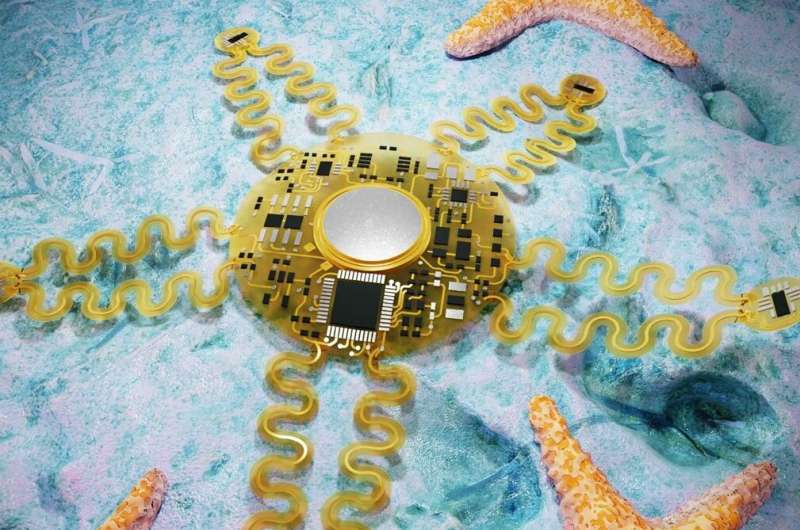
When the body moves, present wearable technologies struggle to reliably track heart rate. However, researchers at the University of Missouri discovered that a starfish’s five-arm form helps to alleviate this difficulty.
Inspired by how a starfish flips itself over—shrinking one of its limbs and using the others in a coordinated action to right itself—Sicheng Chen and Zheng Yan from Mizzou’s College of Engineering, together with collaborators, developed a starfish-shaped wearable gadget that monitors heart health in real time.
Their research, “Starfish-inspired wearable bioelectronic systems for physiological signal monitoring during motion and real-time heart disease diagnosis,” published in the journal Science Advances. Other co-authors at Mizzou include Qunle Ouyang, Xuanbo Miao, Zehua Chen, and Ganggang Zhao.
Because the starfish-inspired gadget has several points that contact the skin around the heart, it is more stable than standard wearables with a single, unified structure, such as a smartwatch. This enables the device to acquire better, more accurate heart data—even while the user is moving.
The device easily connects with a smartphone app to deliver health information and detect potential heart problems.
The researchers created an artificial intelligence-powered system that learns from a significant amount of cardiac data, including signals from both healthy people and those with heart problems. The system uses clever technology to filter out movement-related interruptions and analyze heart signals to identify whether a person’s heart is healthy or displaying indications of illness. The findings are presented on the smartphone app.
This AI-based method properly detects heart problems more than 90% of the time. Because the device has Bluetooth capabilities, clinicians may evaluate the data remotely, making it an ideal choice for at-home monitoring in between medical appointments.
For Comfort and Long-term use
The team is also working to improve the gadgets’ long-term wearability.
Yan, an associate professor in Mizzou’s College of Engineering, said:
“A big challenge with wearable devices is that they can cause skin irritation when worn for long periods,
To solve this, Yan’s team is aiming to make the gadget more comfortable and skin-friendly. Currently, the device adheres to the skin with a specific gel, but future generations will use a breathable, skin-friendly material for increased comfort. Yan’s team has worked on enhancing this substance for several years.
The starfish-inspired device, combining nature, engineering, and AI, could revolutionize heart health management by enabling continuous use and wireless charging without requiring removal.