

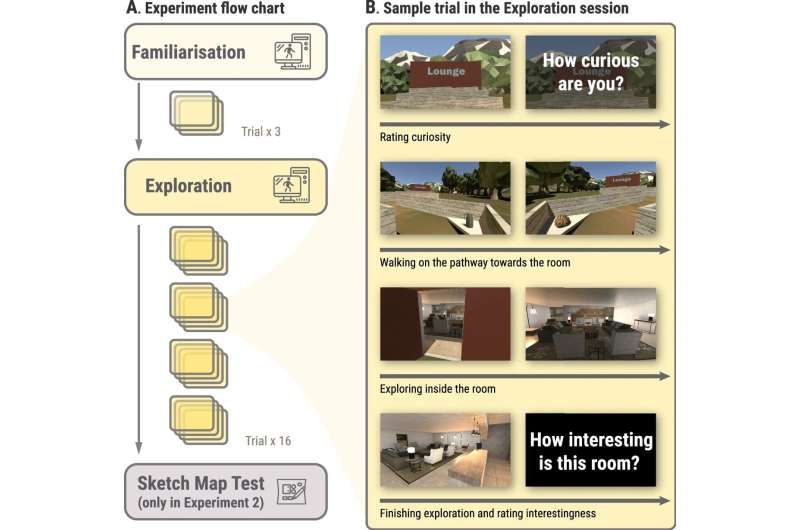
A recent study has shown that curiosity significantly influences how people explore and remember their surroundings. Researchers used virtual reality (VR) technology to better understand the relationship between curiosity, exploration, and spatial memory. The study was conducted by scientists from Cardiff University and Royal Holloway, University of London, who wanted to examine how curiosity shapes the way humans navigate unfamiliar environments.
During the experiment, participants entered a series of sixteen virtual reality rooms that were designed to encourage free exploration. Before entering each room, participants rated how curious they felt about the environment they were about to experience. While inside the VR spaces, researchers carefully tracked the participants’ movements and observed how they visually explored the rooms. After completing the exploration, participants took memory tests to measure how accurately they could remember the layouts and details of the virtual spaces.
The results demonstrated that people who experienced higher levels of curiosity were more likely to explore the rooms thoroughly. They spent more time examining objects and features within the environment, which helped them create stronger mental maps of the spaces. This improved exploration also resulted in better spatial memory and recall.
The researchers additionally discovered that an individual’s ability to tolerate uncertainty affected how curiosity translated into action. Participants who were more comfortable dealing with uncertainty were more willing to actively explore unfamiliar environments. In contrast, individuals with lower stress tolerance explored less, even when they reported feeling curious.
According to the scientists, the findings suggest that curiosity plays an important role in learning and memory formation. They believe virtual reality could become a valuable tool for studying human behavior and may help improve areas such as education, architecture, museum design, urban planning, and gaming by creating environments that inspire curiosity and engagement.
“This is the first time that states of curiosity have been demonstrated to enhance spatial exploration and mental map formation,” says Gruber.
“Understanding the influence of curiosity on human exploration has practical implications for architecture, urban planning, museums, and game designs. By harnessing curiosity, we can positively encourage exploration and memory in real-world or virtual environments.
“In this research, virtual reality has allowed us to expand our understanding of how moment-to-moment changes in situational curiosity can shape our inner world and how we perceive and remember our external world.”
Dr. Carl Hodgetts, from Royal Holloway, University of London, said,
“What’s particularly striking about these findings is that they weren’t driven by a person’s general trait level of curiosity, but rather by how curiosity fluctuated from moment to moment. This has exciting implications for designing real-world spaces and educational environments to better engage and inspire learning.”