

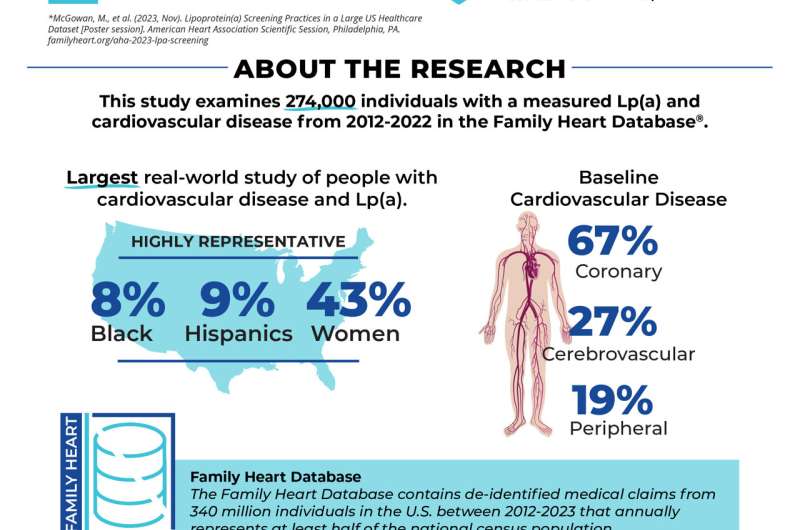
A study has revealed that even slight increases in lipoprotein(a), commonly known as Lp(a), may significantly increase the risk of cardiovascular disease. Lp(a) is a type of cholesterol-related particle largely determined by genetics and is not routinely measured during standard cholesterol testing. Moreover, the findings highlight the importance of greater awareness and screening for this often-overlooked cardiovascular risk factor.
The study examined health data from 273,770 individuals in the United States who were already living with atherosclerotic cardiovascular disease, a condition caused by plaque buildup in the arteries. Participants were monitored for an average of 5.4 years to determine whether they experienced major cardiovascular complications. They include heart attacks, strokes, or procedures like bypass surgery and artery stenting.
“While previous smaller studies have shown that the risk of cardiovascular events can increase within certain ranges of Lp(a), this is the first study to show that the risks of cardiovascular events including heart attack, stroke and cardiac surgeries continue to increase across all ascending levels of Lp(a) and that there is no indication that the risk plateaus,”
said Katherine Wilemon, founder and chief executive officer of the Family Heart Foundation.
“The US has lagged behind many other countries in recommending that adults complete a simple blood test to measure Lp(a). This study strongly confirms the importance of considering Lp(a) levels among other risk factors when determining an individual’s risk of future heart attacks and strokes.”
Researchers discovered a consistent relationship between rising Lp(a) levels and increasing cardiovascular risk. Unlike some other risk factors, there did not appear to be a threshold at which the danger stabilized. Instead, the risk continued to climb as Lp(a) levels increased. According to the researchers, this is the largest study to demonstrate that even small elevations in Lp(a) can contribute to future cardiovascular events.
The findings also showed that women and Black individuals were more likely to have elevated Lp(a) levels compared with other groups. This suggests that some populations may face a greater inherited risk of cardiovascular disease related to Lp(a).
“Among the many important findings in this study, we now know that in people living with cardiovascular disease every nmol/L of Lp(a) confers increased risk of a subsequent cardiovascular event. This is a meaningful advancement in our understanding of the impact of Lp(a) on one’s health,”
said Diane MacDougall, vice president, science and research, Family Heart Foundation, and first author of the study.
“The results further show that the risk increases regardless of what type of cardiovascular disease individuals had initially (in the heart, brain or legs), whether or not they also had diabetes, or their sex or race/ethnicity. The higher the Lp(a) level, the more likely people living with ASCVD are to have another cardiovascular event.”