
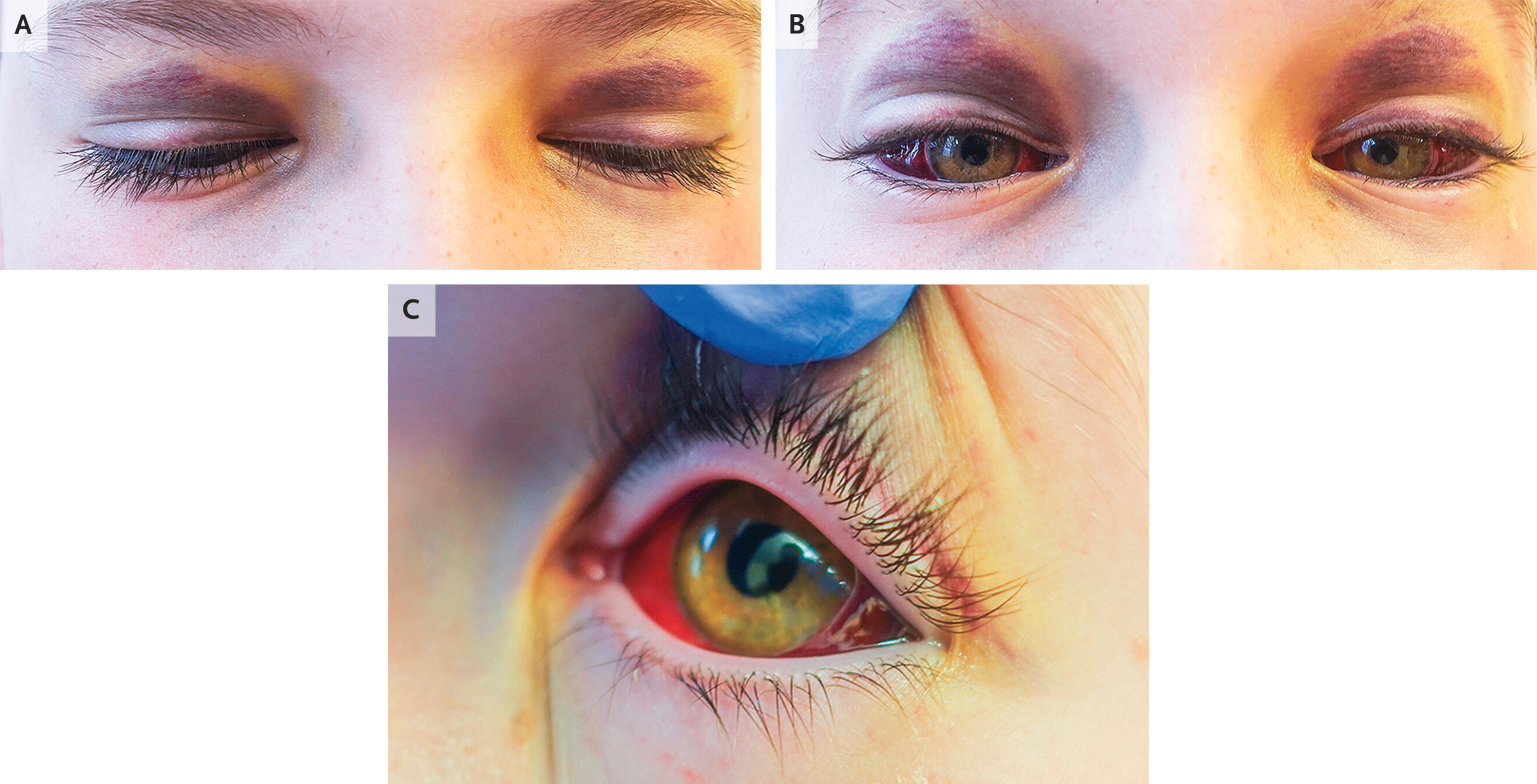
A 10-year-old boy was brought to the emergency department with a 4-day history of progressive bruising around both eyelids. The discoloration had developed gradually and was not associated with any reported trauma. Four weeks before presentation, he had developed a dry cough that had slowly worsened over time, becoming more persistent in the week leading up to his emergency visit. The combination of respiratory symptoms followed by spontaneous periorbital bruising raised concern for an underlying systemic process rather than isolated injury.
On initial examination, the child was noted to have bilateral periorbital ecchymoses, often described as “raccoon eyes.” There was no evidence of external head injury or facial trauma. The remainder of the physical examination revealed signs suggestive of a respiratory condition, including reduced breath sounds in some lung fields and mild respiratory discomfort. Vital signs were otherwise stable, but the history of progressive cough alongside spontaneous bruising warranted further investigation.
Periorbital ecchymosis in children is an uncommon finding and is often associated with a limited number of conditions. While trauma remains the most common cause, spontaneous bilateral bruising around the eyes is a red flag for systemic disease. In this case, the absence of trauma and the presence of respiratory symptoms pointed clinicians toward a deeper underlying cause, particularly involving the chest or upper airways.
One of the most important considerations in such a presentation is a mediastinal mass or conditions that increase intrathoracic pressure. In pediatric patients, a persistent cough accompanied by signs such as periorbital bruising may indicate obstruction or compression within the chest cavity. One well-described mechanism is superior vena cava (SVC) obstruction or impaired venous drainage from the head and neck, which can lead to venous congestion and fragile capillaries around the eyes that rupture easily.
The progression from cough to periorbital ecchymosis suggests that the underlying disease process may have been developing over several weeks. Conditions that commonly produce this pattern in children include mediastinal tumors such as lymphoma, neuroblastoma, or germ cell tumors. Among these, non-Hodgkin lymphoma is particularly important because it can present with a mediastinal mass that causes cough, chest discomfort, and vascular compression symptoms.
Neuroblastoma, another key consideration in this age group, can also present with metastatic spread and systemic signs, including periorbital ecchymosis. In some cases, orbital metastases or infiltration of periorbital tissues can produce characteristic bruising. However, neuroblastoma more commonly presents in younger children, making lymphoma a more likely consideration in a 10-year-old patient.
The cough described in this case is also clinically significant. A dry, progressive cough over several weeks can indicate airway compression, irritation from a mediastinal mass, or early pulmonary involvement. As the mass enlarges, it may press on the trachea or bronchi, leading to worsening respiratory symptoms. In some cases, children may also develop stridor, shortness of breath, or orthopnea if the airway or major vessels are significantly compressed.
Periorbital ecchymosis, often referred to as “raccoon eyes,” typically occurs when blood or fluid tracks into the loose connective tissue around the eyes. In systemic conditions, this can occur due to increased venous pressure, fragile blood vessels, or infiltration of malignant cells. While classically associated with basilar skull fractures in trauma cases, bilateral spontaneous occurrence without injury is highly suggestive of systemic disease and should prompt urgent imaging.
Further evaluation in such cases generally includes chest radiography as an initial step, followed by contrast-enhanced CT scanning of the chest to evaluate for mediastinal masses. Laboratory studies, including complete blood count and lactate dehydrogenase levels, may also provide clues, particularly if there is an underlying hematologic malignancy. Elevated LDH, anemia, or abnormal white cell counts can support the suspicion of lymphoma.
In cases where lymphoma is suspected, tissue biopsy remains essential for definitive diagnosis. Immunohistochemical analysis helps classify the type of lymphoma and guides treatment decisions. Pediatric lymphomas are often aggressive but also highly responsive to chemotherapy when diagnosed early.
The presence of periorbital ecchymosis in this child serves as an important clinical clue. It reflects not only a localized physical finding but also a potential sign of systemic disease involving the thorax or hematologic system. Early recognition of this sign can significantly impact outcomes, as delays in diagnosis of conditions like mediastinal lymphoma can lead to rapid progression and life-threatening complications, including airway obstruction or cardiovascular compromise.
Treatment depends on the underlying diagnosis. If lymphoma is confirmed, multi-agent chemotherapy is the cornerstone of management, often with excellent long-term survival rates in pediatric patients. Supportive care may also be required to manage respiratory symptoms and prevent complications related to tumor burden.
In summary, a 10-year-old boy presenting with progressive periorbital bruising and a preceding history of worsening dry cough raises strong concern for an underlying mediastinal process, most notably a hematologic malignancy such as lymphoma. The combination of respiratory symptoms and spontaneous “raccoon eyes” should prompt urgent investigation, as it may represent a serious but potentially treatable condition. Early recognition and timely intervention are essential to improving outcomes in such cases.
Source: NEJM