
Unilateral Nodular Elastosis with Comedones: A Clinical Presentation of Favre–Racouchot Syndrome
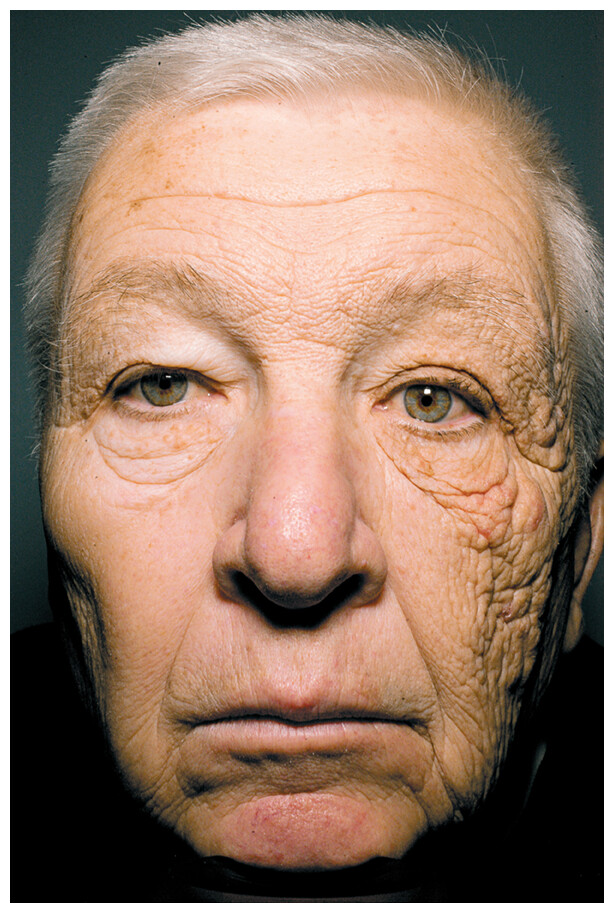
Progressive thickening and wrinkling of facial skin in older adults is a common dermatologic complaint, often attributed to chronic sun exposure and intrinsic aging. However, when these changes are accompanied by hyperkeratosis, prominent ridging, multiple open comedones, and nodular elastosis, a specific diagnosis should be considered. This case describes a 69-year-old man who presented with gradual, unilateral skin changes affecting the left side of his face, a presentation characteristic of Favre–Racouchot syndrome, also known as nodular elastosis with cysts and comedones.
On physical examination, the affected facial skin showed marked hyperkeratosis with exaggerated skin markings, deep wrinkles, numerous open comedones, and areas of nodular elastosis. These findings were confined predominantly to one side of the face, suggesting asymmetric environmental exposure rather than a systemic disorder. Favre–Racouchot syndrome is a chronic dermatologic condition associated with long-standing ultraviolet (UV) radiation exposure and is most commonly seen in elderly men with significant cumulative sun damage.
Favre–Racouchot syndrome is characterized histologically by severe solar elastosis, which refers to the degeneration and accumulation of abnormal elastic fibers in the dermis. Clinically, this manifests as thickened, yellowish skin with deep furrows, nodules, and clusters of open and closed comedones. The periorbital region, temples, cheeks, and neck are frequently affected. Although typically bilateral, unilateral cases have been reported and are often linked to asymmetric sun exposure, such as chronic driving with one side of the face exposed to sunlight through a window.
Pathogenesis
The pathogenesis of Favre–Racouchot syndrome is strongly linked to chronic UV radiation, which induces elastin degeneration, collagen breakdown, and alterations in sebaceous gland function. UV exposure leads to increased matrix metalloproteinase activity, resulting in degradation of normal dermal connective tissue and accumulation of abnormal elastic material. Smoking has also been identified as an independent risk factor, likely due to its synergistic effects on oxidative stress and connective tissue damage. These factors collectively contribute to follicular dilation, keratin retention, and comedone formation.
The differential diagnosis for this presentation includes acne vulgaris, sebaceous hyperplasia, actinic keratosis, cutis rhomboidalis nuchae, and connective tissue disorders such as pseudoxanthoma elasticum. However, acne vulgaris typically presents earlier in life and lacks the pronounced solar elastosis seen in Favre–Racouchot syndrome. Actinic keratoses may coexist but usually appear as scaly, erythematous macules rather than comedonal lesions. The combination of advanced age, chronic sun exposure, nodular elastosis, and comedones is highly suggestive of Favre–Racouchot syndrome.
Diagnosis is primarily clinical, supported by histopathology when necessary. Skin biopsy reveals marked solar elastosis in the reticular dermis, dilated pilosebaceous units filled with keratinous material, and minimal inflammation. Unlike inflammatory acne, there is typically no significant bacterial involvement, reinforcing the degenerative rather than infectious nature of the condition.
Management
Management focuses on both treatment and prevention. Sun protection is a cornerstone of therapy and includes the use of broad-spectrum sunscreens, protective clothing, and behavioral modification to minimize further UV exposure. Smoking cessation is strongly recommended due to its role in disease progression. Topical retinoids are commonly used to promote keratinocyte turnover, reduce comedones, and improve skin texture. In more severe cases, mechanical comedone extraction, dermabrasion, chemical peels, laser resurfacing, or surgical excision of nodular lesions may be employed. While treatment can improve cosmetic appearance and symptoms, the underlying photodamage is irreversible.
This case underscores the importance of recognizing distinctive patterns of photoaging and comedonal disorders in older adults. Unilateral involvement should prompt clinicians to inquire about occupational or lifestyle-related sun exposure. Early identification allows for appropriate counseling on sun protection and risk reduction for associated actinic conditions, including nonmelanoma skin cancers, which frequently coexist with chronic photodamage.
In summary, Favre–Racouchot syndrome is a benign but visually striking manifestation of long-term UV-induced skin damage. Awareness of its clinical features enables accurate diagnosis, differentiation from other dermatologic conditions, and implementation of targeted management strategies to improve quality of life and prevent further photodamage.
References
- Favre M, Racouchot J. Nodular cutaneous elastosis with cysts and comedones. Ann Dermatol Syphiligr (Paris). 1951;78:681–702.
- Patterson JW. Weedon’s Skin Pathology. 4th ed. Elsevier; 2016.
- Naylor MF, et al. Smoking and skin aging. J Am Acad Dermatol. 1991;25(5 Pt 1):836–840.
- Roenigk HH, et al. Favre–Racouchot syndrome: A clinicopathologic review. J Am Acad Dermatol. 1984;10(2):236–242.
- Rabe JH, et al. Photoaging: Mechanisms and repair. J Am Acad Dermatol. 2006;55(1):1–19.