
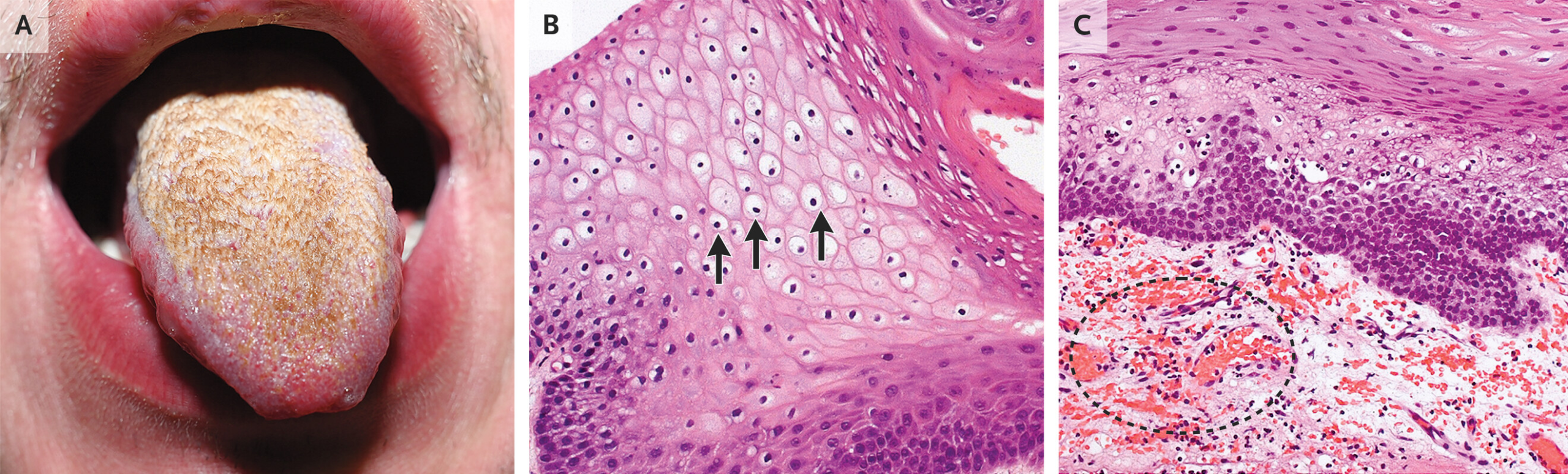
A 38-year-old man with a history of kidney transplantation presented with a 2-week history of an unusual sensation in his mouth described as burning, accompanied by the appearance of “hairy” lesions on his tongue. On examination, the dorsal surface of the tongue showed elongated, discolored papillae giving it a characteristic dark, hair-like appearance. The findings were consistent with hairy tongue (lingua villosa), a benign but often alarming condition.
Hairy tongue is a disorder of the tongue’s filiform papillae, which are the small keratinized projections on the surface of the tongue responsible for texture and friction. Normally, these papillae undergo continuous shedding as part of the natural turnover of oral mucosa. In hairy tongue, this desquamation process is disrupted, leading to excessive accumulation of keratin. As a result, the papillae become elongated and may trap debris, bacteria, fungi, and food pigments, producing the characteristic “hairy” appearance.
In this patient, the immunosuppressed state following kidney transplantation is an important predisposing factor. Transplant recipients are typically maintained on long-term immunosuppressive therapy, such as calcineurin inhibitors, antimetabolites, and corticosteroids, to prevent graft rejection. While these medications are essential for transplant survival, they also alter normal immune surveillance in the oral cavity, increasing susceptibility to infections and changes in the oral microbiome. These factors can contribute to the development of hairy tongue, especially when combined with poor oral hygiene or recent antibiotic use.
Hairy tongue can appear in a variety of colors, depending on the organisms present and external exposures. The papillae may appear white, yellow, brown, or black. Dark discoloration is often due to chromogenic bacteria, tobacco use, coffee or tea consumption, or certain medications. In this case, the elongated, discolored papillae likely reflected a combination of keratin accumulation and microbial colonization.
Patients with hairy tongue may be asymptomatic, but some experience symptoms such as a burning sensation, gagging, altered taste (dysgeusia), or halitosis (bad breath). The burning sensation described by this patient is thought to result from irritation of the hypertrophied papillae or secondary overgrowth of microorganisms. Although the condition can be distressing due to its appearance, it is generally benign and does not indicate malignancy or precancerous change.
The diagnosis of hairy tongue is clinical, based on characteristic appearance of the dorsal tongue. No biopsy or invasive testing is typically required unless atypical features are present or another diagnosis is suspected. Differential diagnoses may include oral candidiasis, leukoplakia, oral hairy leukoplakia (associated with Epstein–Barr virus, particularly in HIV), and pigmented lesions of the oral mucosa. Careful clinical evaluation helps distinguish these conditions.
Oral hairy leukoplakia, in particular, is an important consideration in immunocompromised patients. However, it typically presents as white, corrugated plaques on the lateral borders of the tongue rather than elongated papillae on the dorsal surface. In contrast, hairy tongue primarily involves the filiform papillae on the top of the tongue and is associated with keratin accumulation rather than viral epithelial proliferation.
Management of hairy tongue is usually conservative and focuses on eliminating predisposing factors and restoring normal desquamation of the papillae. The cornerstone of treatment is improved oral hygiene, including regular brushing or scraping of the tongue to mechanically remove excess keratin and debris. Patients are also advised to maintain adequate hydration and avoid contributing factors such as smoking, excessive coffee or tea intake, and unnecessary antibiotic use.
In cases where infection or microbial overgrowth is suspected, antifungal or antibacterial therapy may be considered, although this is not routinely required. In transplant patients like this one, careful review of immunosuppressive therapy and oral care routines is important. Dentists and physicians often work together to ensure that oral hygiene practices are optimized without compromising transplant management.
Resolution of hairy tongue is usually gradual once contributing factors are addressed. The tongue surface typically returns to normal appearance over days to weeks as the keratinized papillae shed naturally. Reassurance plays an important role in management, as the condition is benign but can cause significant anxiety due to its appearance.
This case highlights the importance of recognizing oral manifestations of systemic conditions and medication-related effects. In immunosuppressed individuals, even benign conditions like hairy tongue can be more pronounced due to alterations in immune function and microbial balance. It also underscores the role of routine oral examination in transplant recipients, who are at increased risk for a variety of oral complications, including infections, mucosal changes, and medication-related effects.
In conclusion, hairy tongue is a benign disorder characterized by elongation and discoloration of the filiform papillae due to impaired desquamation and keratin accumulation. In this kidney transplant patient, immunosuppression likely contributed to its development. Although visually striking and sometimes uncomfortable, the condition is reversible with proper oral hygiene and elimination of risk factors. Recognizing its characteristic appearance helps avoid unnecessary investigations and provides reassurance to patients.
Source: NEJM