
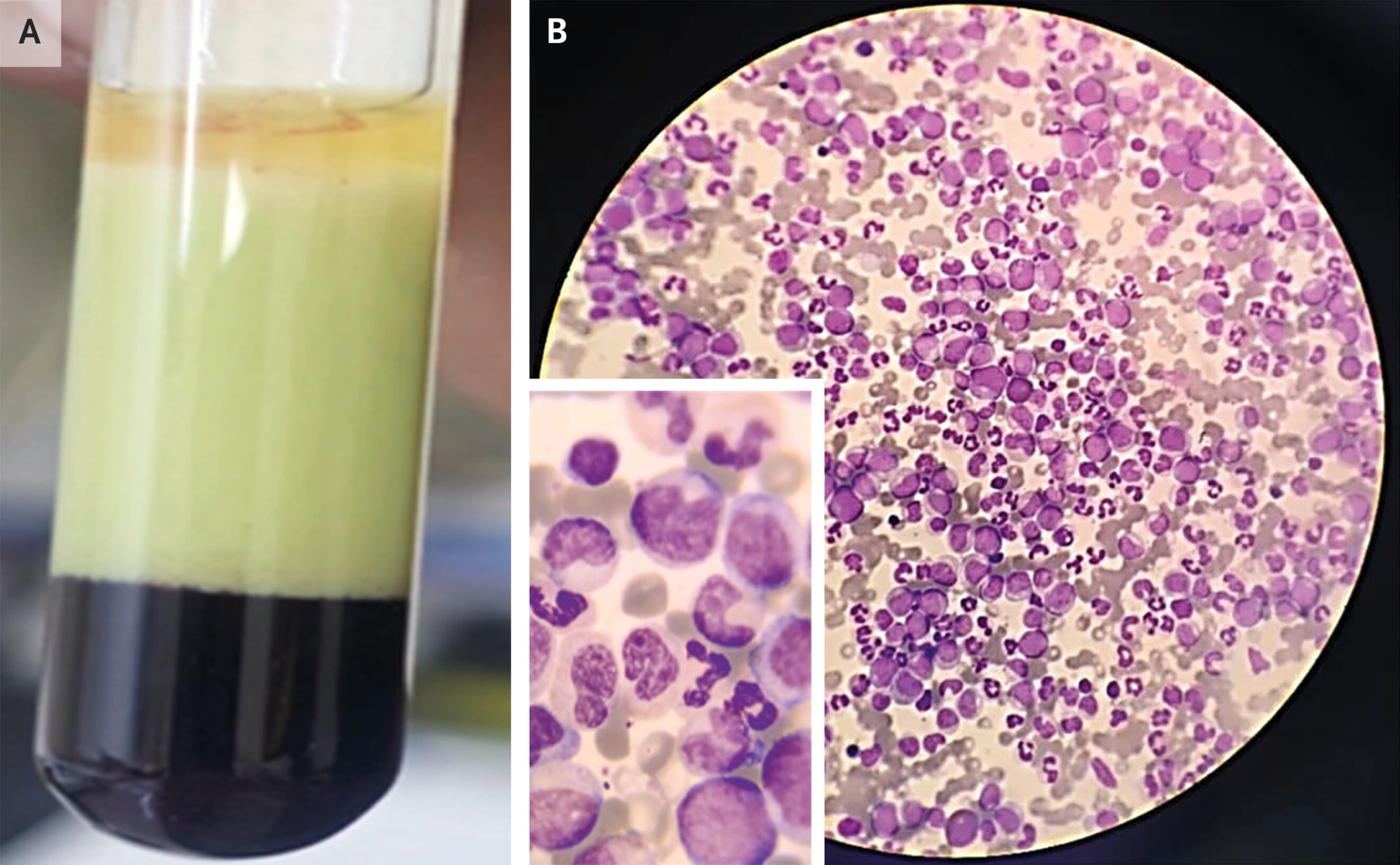
A 64-year-old woman presented with a 5-month history of progressive fatigue accompanied by a more recent 2-week history of fever and cough. On examination, she was found to have generalized lymphadenopathy and splenomegaly. These findings immediately raised concern for an underlying hematologic malignancy or chronic systemic infection. However, one unusual laboratory clue provided an important diagnostic direction: a serum sample revealed a broad, greenish “buffy coat” of cells after centrifugation.
This striking laboratory appearance is not a routine finding and often signals a marked increase in circulating white blood cells. In a normal blood sample, centrifugation separates blood into three layers: a red blood cell layer at the bottom, a thin “buffy coat” of white blood cells and platelets in the middle, and plasma at the top. In this patient, the buffy coat was unusually thick and visually prominent, suggesting extreme leukocytosis.
Chronic myeloid leukemia – a hematologic malignancy
The combination of fatigue, fever, lymphadenopathy, splenomegaly, and a markedly increased white cell fraction strongly points toward a hematologic malignancy, particularly a leukemia or a lymphoproliferative disorder. In older adults, one of the most important considerations in this clinical context is chronic lymphocytic leukemia (CLL) or a related mature B-cell leukemia.
Chronic lymphocytic leukemia is a slow-growing cancer of B lymphocytes characterized by the accumulation of functionally abnormal but long-lived lymphocytes in the blood, bone marrow, lymph nodes, and spleen. According to the American Cancer Society and the National Cancer Institute, CLL is the most common leukemia in adults in Western countries, with a median age at diagnosis of around 70 years. Many patients are asymptomatic at first, and the disease is often discovered incidentally on routine blood tests showing lymphocytosis.
In this case, the patient’s long-standing fatigue likely reflects the gradual buildup of abnormal lymphocytes and associated immune dysfunction. The more recent onset of fever and cough suggests either disease progression or a complication such as infection. Patients with CLL are particularly susceptible to infections because the malignant lymphocytes do not function properly, leading to impaired humoral immunity. Recurrent respiratory infections are common, which may explain her cough and fever.
The presence of lymphadenopathy and splenomegaly further supports a lymphoproliferative process. In CLL, malignant lymphocytes accumulate in lymph nodes and the spleen, leading to painless enlargement of these organs. Splenomegaly may contribute to early satiety, abdominal discomfort, and worsening fatigue due to increased cell turnover and sequestration of blood components.
The most visually striking clue in this case, however, is the “broad, greenish buffy coat” seen after centrifugation of the blood sample. This phenomenon reflects a dramatically increased white blood cell count, often so high that the buffy coat layer becomes visibly thick. In extreme leukocytosis, the buffy coat may appear discolored or turbid due to the overwhelming number of abnormal lymphocytes. While not specific to a single disease, this finding is highly suggestive of leukemia or another severe hematologic disorder.
The greenish tint occasionally described in such samples is thought to be related to the optical density and concentration of leukocytes, as well as plasma protein alterations associated with malignancy or inflammation. Although rare in routine practice, such macroscopic changes in blood components serve as an important visual warning sign for laboratory personnel.
To confirm the diagnosis, further investigations would typically include a complete blood count with differential, peripheral blood smear, flow cytometry, and possibly bone marrow biopsy. In CLL, the peripheral smear often shows a markedly elevated lymphocyte count with small, mature-appearing lymphocytes and characteristic “smudge cells,” which are fragile lymphocytes that rupture during slide preparation. Flow cytometry would demonstrate a clonal B-cell population expressing markers such as CD5, CD19, CD20 (dim), and CD23.
Modern guidelines from organizations such as the European Society for Medical Oncology (ESMO) and the National Comprehensive Cancer Network (NCCN) emphasize that treatment for CLL is not always immediately required. Many patients with early-stage disease are managed with a “watch and wait” approach until symptoms, cytopenias, or organ involvement develop. However, in symptomatic patients—such as this woman with systemic symptoms and splenomegaly—treatment is generally indicated.
Therapeutic options for CLL have evolved significantly in recent years. Traditional chemotherapy regimens have largely been replaced or supplemented by targeted therapies, including Bruton tyrosine kinase (BTK) inhibitors such as ibrutinib and acalabrutinib, as well as BCL-2 inhibitors like venetoclax. These agents have improved survival and reduced treatment-related toxicity, particularly in older adults.
Supportive care is also an important aspect of management. Patients may require antibiotics for infections, immunoglobulin replacement in cases of recurrent infections, and careful monitoring for complications such as autoimmune hemolytic anemia or Richter transformation, where CLL transforms into an aggressive lymphoma.
In summary, this case of a 64-year-old woman with fatigue, fever, lymphadenopathy, splenomegaly, and a strikingly abnormal buffy coat highlights the importance of integrating clinical findings with laboratory clues. The unusual appearance of the blood sample serves as a visual reflection of profound leukocytosis, most consistent with a lymphoproliferative disorder such as chronic lymphocytic leukemia. Early recognition of these signs is essential, as timely diagnosis allows for appropriate monitoring, treatment, and management of complications, ultimately improving patient outcomes.
Source: NEJM