
Gray Skin in an 84-Year-Old Man: Understanding Argyria and Abnormal Skin Pigmentation
When an elderly patient develops a striking change in skin color, it often raises concern for serious systemic disease. In rare cases, however, the cause may be an unusual condition called argyria, where silver accumulates in the body and causes a permanent gray or blue-gray discoloration of the skin. This condition was highlighted in a recent clinical case of an 84-year-old man who developed diffuse gray skin, along with pigmentation of his nails and sclera (the whites of the eyes).
This article explains the condition in a clear, reader-friendly way and explores how it develops, how it is diagnosed, and what it means for patients.
What Was Seen in This Case?
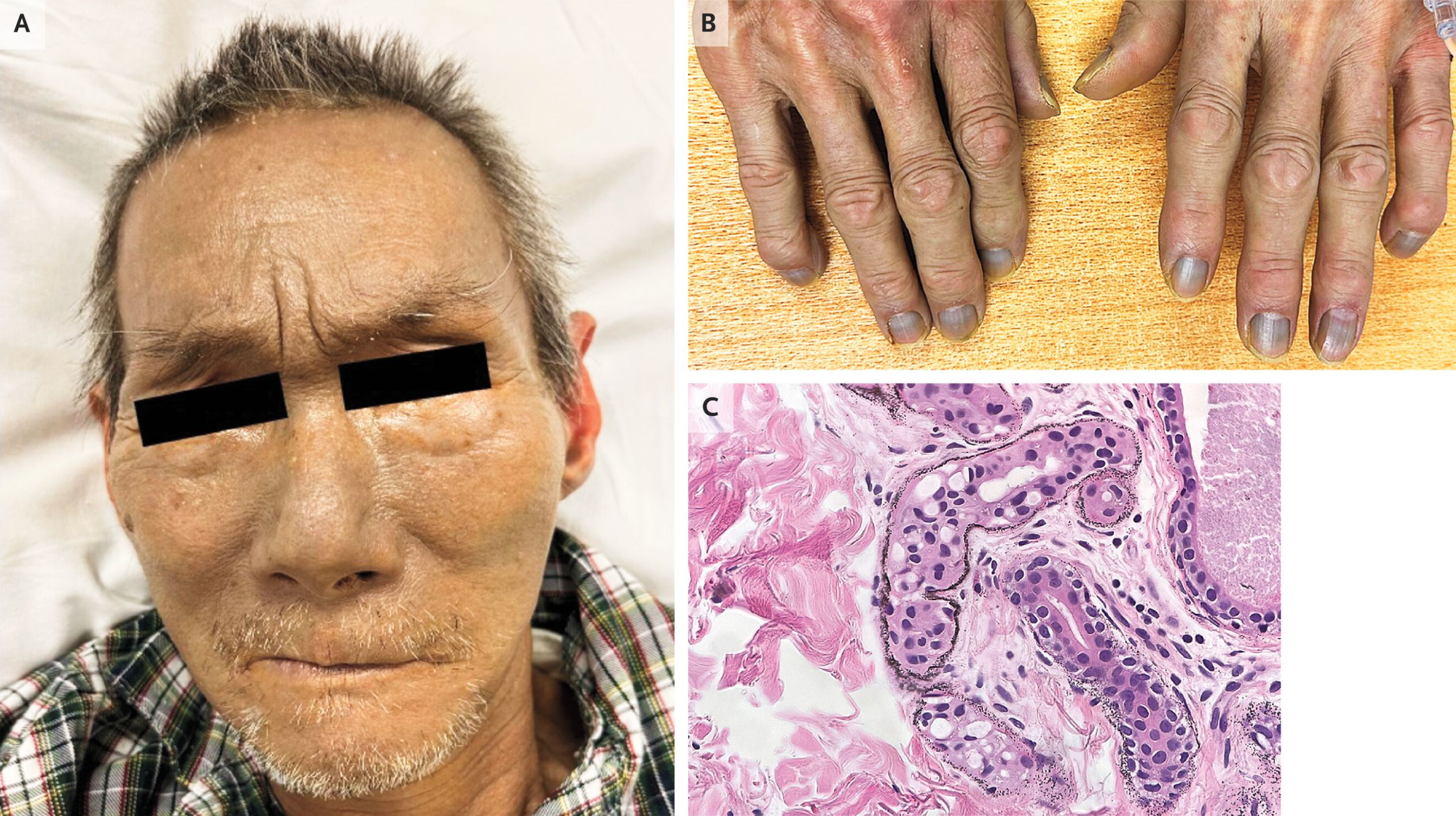
The patient was an 84-year-old man who was noted to have diffuse gray discoloration of the skin. On examination, the pigmentation was not limited to one area. It affected:
- The skin (especially exposed areas)
- The nails
- The sclera (white of the eyes)
This combination of findings strongly suggested a systemic process rather than a localized skin condition.
A skin biopsy provided the key diagnostic clue: doctors found small dark granules within structures in the skin, including the sweat glands. These deposits are characteristic of silver accumulation in tissues.
Findings like these are classic for generalized argyria, a rare condition caused by long-term exposure to silver compounds. Similar biopsy patterns involving sweat gland basement membranes have been widely described in medical literature on argyria.
What Is Argyria?
Argyria is a condition caused by chronic exposure to silver, leading to its buildup in the body’s tissues. Once deposited, silver particles undergo chemical changes—especially when exposed to sunlight—and create a permanent blue-gray or slate-gray coloration of the skin.
Medical studies describe argyria as:
- Rare but well-documented
- Usually irreversible
- Primarily cosmetic, though psychologically distressing
In generalized argyria, the discoloration is often most visible on:
- Sun-exposed skin (face, hands)
- Nails
- Mucous membranes and eyes
The change happens gradually, often over years, which means patients may not notice it early on.
How Does Silver Change Skin Color?
The key mechanism behind argyria involves silver particles depositing in tissues.
Once in the body, silver:
- Circulates through the bloodstream
- Deposits in skin, sweat glands, and connective tissue
- Reacts with light (especially UV light from the sun)
- Forms dark-colored compounds that permanently tint the skin
Medical literature confirms that these deposits are often found in the basement membranes of sweat glands, blood vessels, and dermal connective tissue, exactly as seen in biopsy specimens from affected patients.
What Causes Silver Exposure?
Historically, argyria was more common in people working in mining, photography, or silver manufacturing. Today, cases are rare but still occur.
Possible sources include:
- Colloidal silver supplements (unregulated alternative medicine products)
- Silver-containing medications (rare in modern practice)
- Occupational exposure in industrial settings
- Long-term use of silver-containing topical products
In many modern cases, no clear source is identified, making the diagnosis more challenging.
Symptoms of Argyria
Argyria is usually not painful and does not directly damage organs in most cases. However, it produces a striking and permanent cosmetic change.
Common features include:
- Gray, blue-gray, or slate-colored skin
- Increased pigmentation in sun-exposed areas
- Darkened nails
- Discoloration of sclera and mucous membranes
Importantly, most patients do not feel sick, which is why the condition is often discovered incidentally during examination for unrelated issues.
Some older reports suggest that extremely high silver exposure may have minor effects on other organ systems, but overall toxicity is considered low compared to its dramatic cosmetic appearance.
How Is Argyria Diagnosed?
Diagnosis is based on a combination of:
1. Clinical examination
The characteristic gray-blue discoloration raises suspicion.
2. Medical history
Doctors look for exposure to silver-containing products or supplements.
3. Skin biopsy
This is the confirmatory test. It shows:
- Dark granules in the dermis
- Deposits in sweat glands and blood vessel walls
- Distribution consistent with silver particles
These findings are considered diagnostic of argyria.
Conditions That Can Look Similar
Several other diseases can cause generalized skin darkening, so argyria must be distinguished from:
- Hemochromatosis (iron overload)
- Addison’s disease (adrenal insufficiency)
- Drug-induced pigmentation (e.g., minocycline)
- Metabolic disorders such as ochronosis
Careful biopsy findings help differentiate argyria from these conditions.
Treatment and Outlook
Unfortunately, there is no effective treatment to remove silver from the body once it is deposited in tissues.
Management focuses on:
- Identifying and stopping further silver exposure
- Providing reassurance when appropriate
- Cosmetic counseling or dermatologic camouflage techniques
Some laser therapies have been explored for cosmetic improvement, but results are limited.
The condition is generally considered benign in terms of physical health, but it can have a significant psychological and social impact due to visible skin changes.
- Argyria is a rare condition caused by long-term silver exposure.
- It leads to permanent gray-blue discoloration of skin, nails, and eyes.
- Diagnosis is confirmed by biopsy showing silver granules in skin structures.
- It is usually harmless medically but irreversible cosmetically.
- Prevention by avoiding unnecessary silver exposure is the most important step.
Conclusion
The case of the 84-year-old man with diffuse gray skin highlights a classic but rare dermatologic condition. Argyria serves as a reminder that environmental and chemical exposures can leave lasting marks on the human body—sometimes quite literally changing its color.
Although uncommon today, it remains an important diagnosis for clinicians evaluating unexplained generalized pigmentation, especially when biopsy reveals characteristic silver deposits in the skin.
Source: NEJM