
People with severe hearing loss can benefit from cochlear implant surgery. It involves implanting an electrical device inside the inner ear. Surgeons must first perform a mastoidectomy, which involves removing a portion of the bone behind the ear, in order to access the inner ear. It is challenging to predict using conventional image-analysis tools. Since the shape of this surgically generated hollow varies from patient to patient and lacks a distinct outside limit. Improved vision for surgeons, navigation systems, robotic instruments, and better patient outcomes could all be supported by a more accurate prediction of this form prior to surgery.
For years, scientists have tried to develop computer algorithms that can accurately anticipate mastoidectomy morphology. According to the Journal of Medical Imaging, a team of researchers from St. Mary’s University, Trinity University, Vanderbilt University, and the Center for Advanced AI has created an artificial intelligence system. That forecasts how much bone will be removed during a critical step in cochlear implant surgery. Their method could make surgery planning safer and more efficient, particularly in situations when professionals cannot manually classify massive quantities of medical pictures.
The Working:
The study team developed a two-part AI system. That learns from medical photos even when clean, hand-labeled data is not available.
1. The technique compares pre- and post-surgery CT scans to determine which bones were removed. Even though the post-surgery photos are noisy. The AI employs a mathematical comparison that emphasizes overall structure rather than tiny details. This allows it to learn the bone-removal pattern without requiring expert instructions.
2.The predictions from the first model serve as “weak labels” for the second model. This second model employs a specialized 3D loss function based on the Student-t distribution to accommodate chaotic or faulty data. This phase enhances the accuracy and reliability of the final prediction.
Together, these two stages constitute a novel method of training medical imaging systems that works even when complete training data is impossible to obtain.
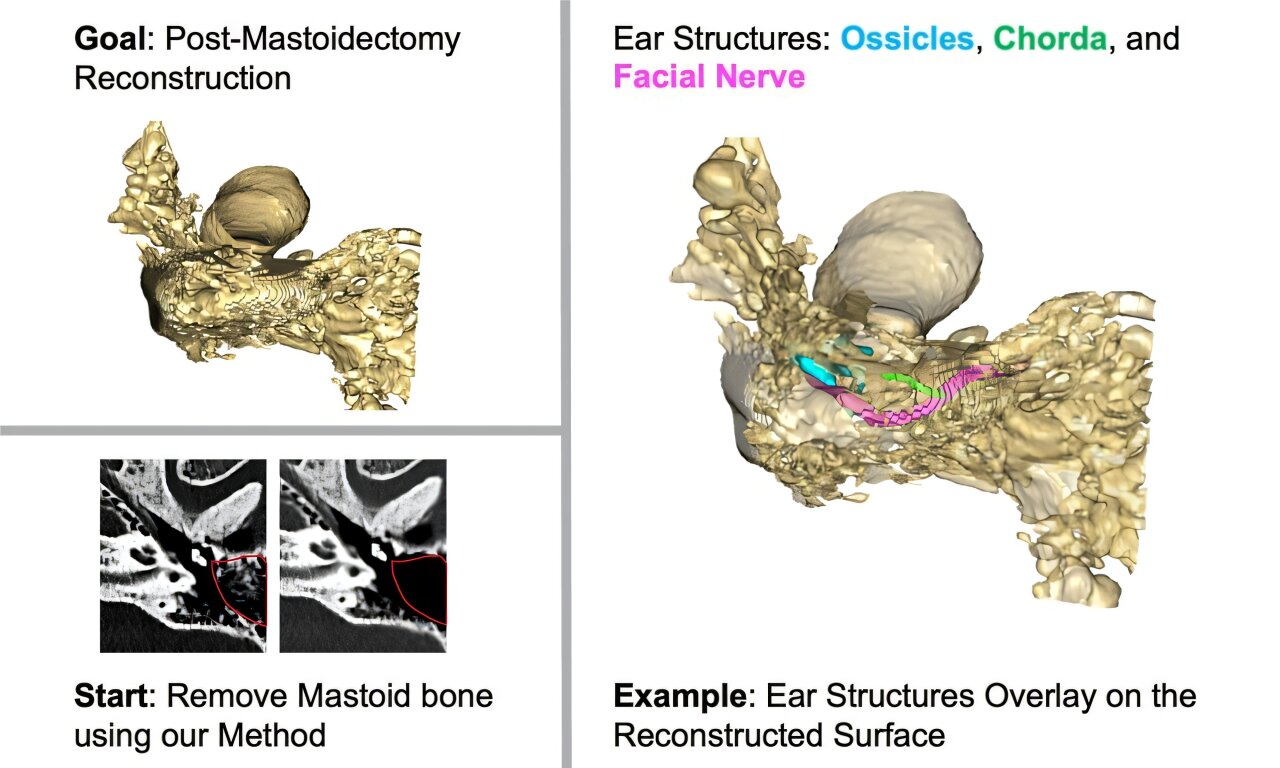
The team also demonstrated that they could generate a 3D model of the projected post-surgery bone surface. This could one day assist surgeons during operations or instruct medical students.
For patients, the technique may someday make cochlear implant surgery safer by providing doctors with a more accurate image of what to expect. It may also assist robotic tools or advanced navigation systems in the operating room.