

Case Report
Intussusception is a medical disorder in which the proximal segment of the intestine (intussusceptum) intrudes into the lumen of the distal segment of the intestine (intussuscipiens). Retrograde intussusception, which involves the invagination of the distal section of the intestine into the proximal segment, is rare.
Intussusception is an urgent condition that causes obstruction of intestinal content passage. And if the intestine does not return to its normal position, it can stop the blood flow through the affected part of the intestine, leading to ischemia of the affected part within a few hours and eventually causing the death of the affected part of the intestine.
In addition to ischemia, the damaged portion of the intestine may become perforated or infected. This condition necessitates immediate medical treatment and is often treated surgically.
Intussusception is the primary cause of intestinal blockage in children aged 6 months to 3 years, accounting for 95% of all invaginations. The most prevalent type of intussusception in childhood is ileocolic intussusception. At that age, more than 90% of patients have no diseased substrate of the intestinal wall that is causing intussusception, and the etiology is unknown. However, it is thought that intussusception may develop more frequently in children with a family history of gastrointestinal issues.
Signs And Symptoms
Children’s symptoms, like adults’, are ambiguous, with the most common being a sudden, loud cry. This is caused by sudden, severe stomach pain in an otherwise healthy youngster.
Other symptoms include vomiting, bloody stools, fever, lethargy, bile vomiting, diarrhea, sweating, dehydration, and an enlarged belly. If left untreated, it can result in illness or even death.
Imaging is essential for diagnosis, particularly in the case of youngsters. In the case of youngsters, a water-soluble contrast or air enema may be considered. And if perforation occurs, early surgical surgery is recommended.
In adults, intussusception accounts for 5% of all obstructions. And usually its starting point is a well-defined pathological change in as many as 70-90% of cases. In most cases, the cause is a neoplastic or nonneoplastic change in the intestinal wall. While in the remaining 15-25% of patients with a known cause of intussusception, the cause is intestinal adhesions or postoperative complications.
In this case, the correlation of intussusception with various pathological conditions such as viral infections, parasites, appendicitis, celiac disease, cystic fibrosis, and Crohn’s disease is highlighted. A case of idiopathic ileo–ileal intussusception is presented involving a Croatian Caucasian male, revealed through X-ray and CT imaging, characterized by air–fluid levels, a visible double wall, and mild haziness in surrounding fatty tissue, along with symptoms of abdominal pain, fever, and nausea.
Early recognition and diagnosis of intussusception are crucial for optimal patient outcomes. Imaging plays a vital role, with computerized tomography being preferred for adults. Urgent surgical intervention is the recommended treatment method.
Case Presentation
A 67-year-old Caucasian, Croatian adult male from Zagreb with a history of arterial hypertension arrived at the emergency department complaining of diffuse abdominal pain and nausea. He had vomited numerous times, discharging both gastrointestinal contents and acid regurgitation. The discomfort had been there for three days. But in the last few hours before arriving at the emergency department, it increased and moved to the epigastric region. He had a minor fever two days ago, reaching 37.6 °C, but had been afebrile the prior days. And denied having chest pain or difficulties breathing. He had vomited his stomach contents several times after meals.
His medical history included only arterial hypertension for the past 15 years, with no associated intestinal diseases. There was no history of gastrointestinal illnesses in the family.
In terms of functions and habits, his current appetite was diminished. And his last bowel movement was 2 days ago without any pathological findings. Urination was normal, he does not smoke, and he does not consume alcohol.
Investigation
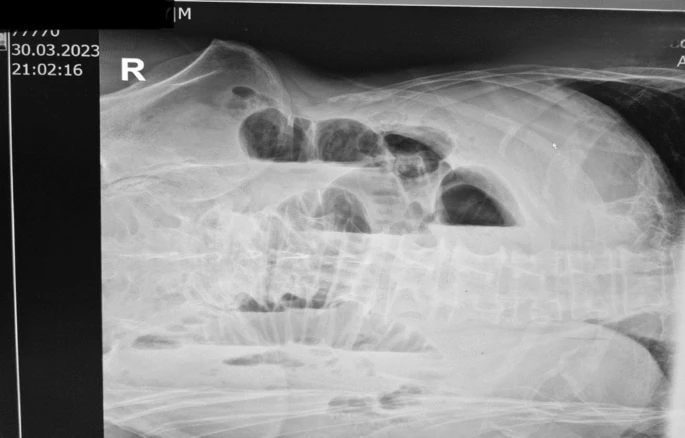
The patient was referred for an abdominal X-ray. The X-ray of the abdomen in the left lateral decubitus position showed prominently shaped loops of the small intestine with air–fluid level. It is indicative of dilated loops of the small intestine, suggestive of ileus
Following the description of dilated intestinal loops with air-fluid levels. As well as laboratory findings showing creatinine levels at the upper limit of physiological values.
An emergency multislice CT scan of the abdomen and pelvis, both native and post-contrast in the portal-venous phase, revealed ileus of the duodenum, jejunum, and proximal half of the ileum with luminal widths up to 47 mm on axial sections. The ileum had thickened walls of up to 12 mm, with a transition zone of the ileum displaying a target sign on the coronal section, indicating a bowel loop located within the lumen of another bowel loop/intussusception. And a visible kidney sign on the axial section, confirming the diagnosis radiologically. Free fluid was found interintestinally, paracolically, and in the small pelvis.
The parenchymal organs appeared within physiological limits during the CT evaluation of the abdomen and pelvis. The abdominal aorta was properly calibrated and opacified. A naso-gastric tube was inserted.
Lab results revealed leukocytosis, microcytosis, anisocytosis, and hypochromia. The serum CRP level was 181.9 mg/L. The urine analysis results were normal.
Management
Next, an emergency operation was performed: ileal segment excision with end-to-end anastomosis (medial laparotomy). Exploration revealed a twisted ileal loop with obvious intussusception. The mentioned loop was gangrenous, thus it was removed and an end-to-end anastomosis (TT anastomosis) was performed. Abdominal cavity lavage involved inserting a drain into the pelvic cavity and exiting through the right lower quadrant.
The postoperative analysis revealed an 18-cm section of gangrenous small intestine due to intussusception. The intestine appeared dark brown to black, with a partly thinned, edematous wall and a lumen filled with bloody content. Greenish deposits were noted on the serosa. Histological examination indicated necrosis of all intestinal wall layers, with observed erythrocyte extravasation and granulocyte accumulation infiltrating the surrounding fatty tissue.
The patient’s diagnosis was confirmed as K56.2 Intussusception and volvulus of the ileum. After surgery, the patient felt well, maintained a normal appetite and bowel movements, and exhibited age-appropriate vital signs. Examination revealed a soft and nontender abdomen with a normal scar, and follow-up X-ray showed normal findings.
The patient was discharged from the hospital in good condition and advised to continue home care, with a follow-up scheduled with the primary care physician.