
A 63-year-old man with a prior history of coronary artery bypass grafting (CABG) presented with a 2-month history of exertional chest discomfort. Interestingly, his symptoms were consistently triggered not by typical walking or climbing stairs, but by exertion of his left arm. This unusual pattern of angina raised concern for a vascular mechanism involving altered blood flow rather than simple progression of coronary artery disease.
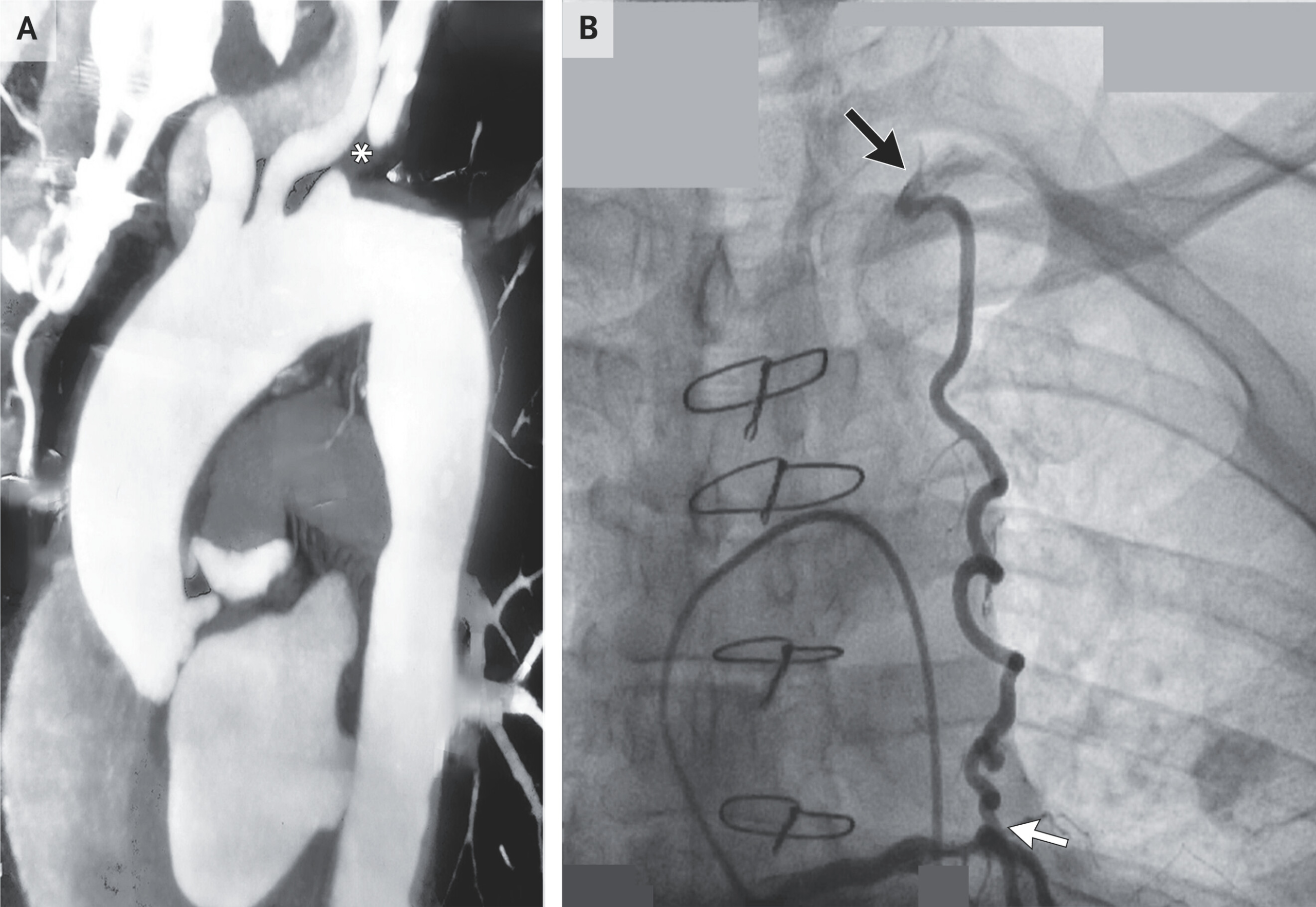
Given his surgical history, clinicians proceeded with coronary angiography to evaluate graft patency. The imaging revealed a striking finding: retrograde flow in the left internal thoracic (mammary) artery graft, suggesting that blood was being diverted away from the coronary circulation under certain conditions. This observation pointed toward a diagnosis of coronary-subclavian steal syndrome, a rare but important complication in patients with internal thoracic artery grafts.
The internal thoracic artery (ITA), formerly known as the internal mammary artery, is one of the most commonly used conduits in CABG surgery, particularly for bypassing the left anterior descending (LAD) coronary artery. It is favored because of its excellent long-term patency compared with vein grafts. In a standard configuration, the ITA remains connected to its origin from the subclavian artery, and blood flows through it into the coronary circulation, supplying oxygen-rich blood to the myocardium.
However, this normal flow pattern can be disrupted if there is a significant blockage or narrowing in the proximal subclavian artery. When the subclavian artery is stenosed proximal to the origin of the ITA, blood flow may be compromised in the arm on that side. During physical activity involving the affected arm, the demand for blood increases. If the proximal subclavian artery cannot meet this demand, blood may be “pulled” backward from the coronary circulation through the ITA graft to supply the arm. This phenomenon is known as subclavian steal, and when it involves a coronary bypass graft, it becomes coronary-subclavian steal syndrome.
In this patient, exertion of the left arm likely increased demand for blood flow to the upper limb. Because of an underlying stenosis in the left subclavian artery, blood was diverted retrogradely from the coronary circulation through the left internal thoracic artery graft. This resulted in reduced perfusion of the myocardium, leading to exertional angina specifically triggered by arm activity rather than general exertion.
The clinical presentation of coronary-subclavian steal syndrome can be subtle and easily overlooked.
Patients may report angina that is reproducibly associated with arm movement, particularly on the side of the ITA graft. In some cases, there may also be symptoms of upper limb ischemia such as fatigue, cramping, or weakness in the affected arm. A key clinical clue is a significant difference in blood pressure between the two arms, with the affected side showing lower readings due to proximal arterial stenosis.
This condition is well described in cardiovascular literature and is recognized as a rare but important cause of recurrent angina after CABG. According to cardiology guidelines and reviews from sources such as the American Heart Association and the European Society of Cardiology, subclavian artery stenosis is often caused by atherosclerosis, particularly in older patients with risk factors such as hypertension, diabetes, smoking, and hyperlipidemia. Less commonly, it may result from vasculitis or prior radiation therapy.
Coronary angiography in this case demonstrated retrograde flow in the left internal thoracic artery graft, which is a hallmark diagnostic finding. Under normal circumstances, flow through the ITA graft should be antegrade, moving from the subclavian artery into the coronary circulation. Reversal of this flow indicates a pressure gradient favoring the arm circulation over the coronary circulation, confirming the presence of a steal phenomenon.
Additional diagnostic tools may include duplex ultrasonography of the subclavian artery, computed tomography angiography, or magnetic resonance angiography. These imaging modalities can identify the site and severity of stenosis and help guide treatment decisions.
Management of coronary-subclavian steal syndrome focuses on restoring adequate blood flow to the subclavian artery.
In many cases, percutaneous transluminal angioplasty with stenting of the stenotic segment is the preferred initial treatment. This minimally invasive approach can effectively restore normal antegrade flow, eliminating the steal phenomenon and relieving angina. In more complex cases, surgical bypass of the subclavian artery may be required.
Medical therapy, including antiplatelet agents and aggressive risk factor modification, is also essential to prevent progression of atherosclerotic disease. However, medical therapy alone does not correct the mechanical obstruction causing the steal phenomenon.
This case highlights an important principle in cardiovascular medicine: not all post-CABG angina is due to graft failure or progression of coronary disease. In patients with internal thoracic artery grafts, especially when symptoms are triggered by arm exertion, clinicians must consider subclavian artery disease as a potential underlying cause.
In conclusion, the presentation of exertional angina triggered by left arm activity in a patient with a left internal thoracic artery graft should raise strong suspicion for coronary-subclavian steal syndrome. The angiographic finding of retrograde graft flow confirms the diagnosis and reflects a hemodynamic reversal caused by proximal subclavian artery stenosis. Early recognition is crucial, as this condition is highly treatable and can lead to complete resolution of symptoms once normal blood flow is restored.
Source: NEJM