
Recognition of pulmonary embolism
A 90-year-old man with a known history of atrial fibrillation presented to the emergency department with sudden-onset shortness of breath. He was previously functional for his age but developed acute dyspnea without chest pain, fever, or cough. Given his age and cardiac history, clinicians were immediately concerned about a cardiopulmonary cause, particularly pulmonary embolism.
Initial vital signs showed tachypnea and mild hypoxemia, but he remained hemodynamically stable. On physical examination, there were no signs of overt heart failure such as peripheral edema or elevated jugular venous pressure. Lung auscultation was relatively unremarkable, with no focal crackles or wheeze. However, the sudden nature of his symptoms raised concern for an acute vascular event.
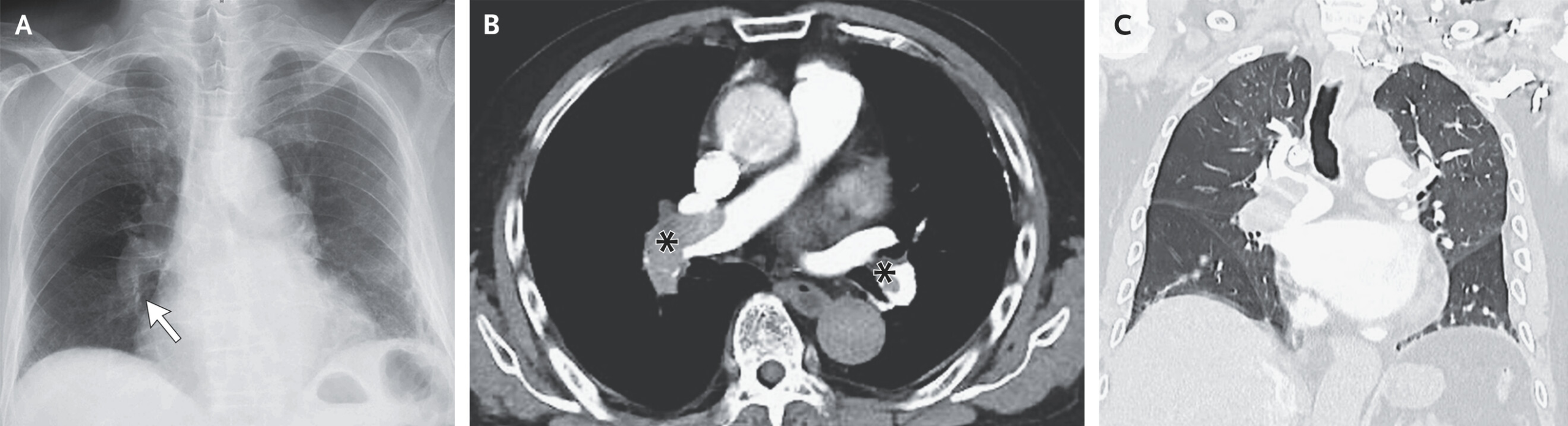
A chest radiograph was performed as part of the initial workup. The imaging revealed two important findings: first, a marked reduction in pulmonary vascular markings in the right lung fields, described as a “paucity of pulmonary vasculature,” and second, enlargement of the right descending pulmonary artery. These radiographic features are classic clues pointing toward obstruction of blood flow to the lung, most commonly due to a pulmonary embolism.
Pathophysiology of pulmonary embolism
Pulmonary embolism (PE) occurs when a thrombus, usually originating from deep veins in the lower limbs or pelvis, travels to the pulmonary arteries and blocks blood flow. In elderly patients, especially those with atrial fibrillation, the risk is significantly increased due to venous stasis, reduced mobility, and a hypercoagulable state. According to guidelines from the American College of Chest Physicians (CHEST) and the European Society of Cardiology, atrial fibrillation is a major risk marker for thromboembolic disease, although it more commonly causes systemic emboli; the overall comorbid risk profile in such patients often overlaps with venous thromboembolism risk factors.
The “pruned” appearance of pulmonary vasculature seen on chest radiography is a well-described but sometimes underappreciated sign of pulmonary embolism. When a major pulmonary artery is occluded, blood flow is reduced distal to the obstruction, leading to decreased visibility of peripheral vascular markings. At the same time, the proximal vessel may appear enlarged due to increased pressure or partial obstruction. The enlarged right descending pulmonary artery seen in this patient reflects this hemodynamic imbalance.
Although chest radiography is not diagnostic for pulmonary embolism, it plays an important role in excluding other causes of acute dyspnea such as pneumonia, pneumothorax, or pulmonary edema. In PE, chest X-ray findings are often nonspecific, but certain classic signs may provide important clues. These include Westermark sign (regional oligemia), Hampton’s hump (wedge-shaped infarct), and enlarged central pulmonary arteries. However, modern diagnosis relies primarily on computed tomography pulmonary angiography (CTPA), which directly visualizes intravascular thrombi.
In this patient, the clinical suspicion for pulmonary embolism would be high given the abrupt onset of dyspnea and suggestive radiographic findings. According to major cardiovascular guidelines, further evaluation would typically include D-dimer testing in low-risk patients or immediate CTPA in high-risk presentations. In elderly patients, D-dimer levels are often elevated even without thrombosis, limiting specificity; therefore, imaging plays a more decisive role.
The pathophysiology of pulmonary embolism involves mechanical obstruction of pulmonary arteries, leading to increased pulmonary vascular resistance. This results in right ventricular strain, impaired gas exchange, and ventilation-perfusion mismatch. If the clot burden is large, it can lead to acute right heart failure and hemodynamic collapse. In this case, the enlargement of the pulmonary artery suggests a significant vascular obstruction affecting pulmonary circulation.
Management of acute pulmonary embolism
Management of acute pulmonary embolism depends on severity. In hemodynamically stable patients, anticoagulation is the mainstay of treatment. Agents such as low molecular weight heparin, direct oral anticoagulants, or unfractionated heparin are used to prevent further clot propagation while the body gradually breaks down the existing thrombus. In high-risk cases with shock or hypotension, thrombolytic therapy or surgical embolectomy may be considered. Given this patient’s advanced age, treatment decisions would also carefully balance bleeding risk against the benefits of anticoagulation.
Atrial fibrillation in this context is clinically important not because it directly causes pulmonary embolism, but because it often coexists with conditions that increase thromboembolic risk, such as immobility, heart failure, and vascular disease. Many elderly patients with atrial fibrillation are already on anticoagulation for stroke prevention, which may reduce but not eliminate the risk of venous thromboembolism.
This case underscores the importance of recognizing subtle radiographic signs in patients presenting with acute respiratory symptoms. While chest radiography alone cannot confirm pulmonary embolism, findings such as reduced vascular markings and enlargement of central pulmonary arteries should prompt urgent further investigation. In elderly patients, where clinical presentation may be nonspecific, careful interpretation of imaging can significantly influence timely diagnosis.
In conclusion, the combination of sudden-onset dyspnea and chest radiographic findings of diminished pulmonary vascular markings with an enlarged pulmonary artery strongly suggests pulmonary embolism. This case highlights the critical role of integrating clinical suspicion with imaging findings to rapidly identify a potentially life-threatening but treatable condition.
Source: NEJM