
The monitoring of fetus at home may be altered by a new wearable gadget. Pregnant mothers may now measure their unborn child’s heartbeat without the use of sticky, uncomfortable gel-based electrode sensors or direct skin contact. Thanks to a comfortable, portable garment created by Ph.D. researcher Yijing Zhang of the Department of Electrical Engineering. The method is straightforward and appropriate for daily usage because the integrated dry electrodes pass through clothing.
Zhang explains:
Current home monitors often work only through direct skin contact, and the gel applied to the skin can cause irritation. It doesn’t feel comfortable and is less effective
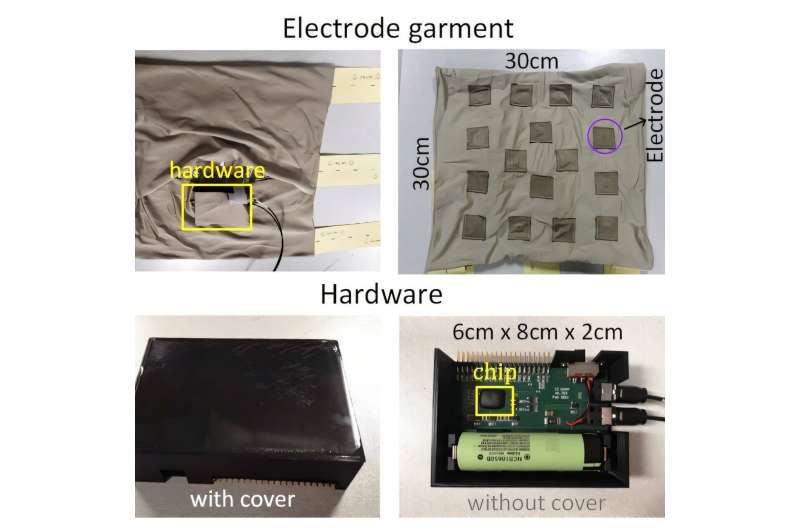
She created a wearable garment with several integrated electrodes. And specialized data-acquisition gear based on a proprietary integrated-circuit chip during her doctoral studies.
Zhang concentrated her research on reducing noise during readings to make sure her wearable monitor functions as well as a conventional gel-based sensor.
The heartbeat of an unborn child is weak, so you want as little interference as possible to be able to detect it properly. The influence of the mother’s breathing and movement is significantly greater with this wearable dry sensor variant. Traditional sensors are more stable because there is more direct contact between the measuring device and the body.”
Noise is caused not just by human physiological reactions but also by Zhang’s wearable’s electrodes and electronic circuitry. In order to lessen noise from various sources, the Ph.D. researcher investigated cutting-edge methods. In order to successfully reduce this noise, she developed creative solutions, such as a rapid reset strategy and a hybrid amplifier construction.
Both pregnant parents and hospitals stand to gain from simplifying home monitoring throughout pregnancy. Mothers can readily check on the health of their unborn kid, which gives them peace of mind. The hospital then receives the data from home monitoring, enabling remote assistance. They can act quickly if something is amiss, Zhang says.
Additionally, it saves time for both parties: medical staff may concentrate on other duties, and parents don’t need to attend the hospital for every check-up. Another benefit, according to Zhang, is that “in countries where people live far from hospitals, this is an alternative to prenatal care.”